(For G. recently diagnosed with cancer.)
My dear friend and sister in the Lord,
Yesterday you confided that you received the invitation from the one who loves you to come away:
"Arise, my darling, my beautiful one, and come with me," the letter said. Song of Songs 2:10
Yes, it is He---for whom your soul longs-- who is calling and your heart says "yes." But you are quivering. You are afraid.
You do not know where you are going, so you are afraid. Perhaps, you are afraid because you think you are not ready. Perhaps, other loves are calling you and you hesitate to leave.
But you have been yearning for Him all your life, have you not?
In your heart of hearts, you know you do. But all of these other loves have been keeping you away. But this "Jealous One" that you speak of, loves with a love that will not let go. He wants you. His desire is for you. He stood at your door one day and banged harder so you can hear Him. You finally opened the door and He asks you. And you decide, of your own free will:Yes,I will go.
You are on the brink, ready to step out into this great and fearful voyage. You know, as I do, that it won't be easy. You will come upon valleys of darkness and deep silence, where your enemy is waiting for you and your Beloved seems distant, or absent. This is how you will learn to live faith. This is when you need the prayers of your people to lift you up. You are not alone. We are with you--as God is with us-to carry you through.
"Your journey has been charted in advance, the trail has been blazed, and the path is engraved in your heart. Your path---the path set out for you--was born into you when you were born into the kingdom of God...the way is Jesus Himself--when you walk in Him, you have found your way...Bring nothing with you except a tender and teachable spirit."1
Surely, He will fulfill His purposes for you. He will reveal His power through you. Like a refiner's fire, out of your jagged rock, all the dross will be burned to bring out a pure, and holy gem of beauty, a vessel of His grace, created and refined for His glory. For this reason you were made. For this reason He is calling you now;for this reason you are going away.
And as you are getting yourself ready for the journey, He tells you to trust Him.
"But now, this is what the Lord says--
He who created you, O Jacob,
He who formed you, O Israel:
Fear not, for I have redeemed you,
I have summoned you by name; you are mine.
When you pass through the waters, I will be with you:
When you pass through the rivers, they will not sweep over you.
When you walk through the fire, you will not be burned;
the flames will not set you ablaze."
Isaiah 43:12
Listen to His voice in the stillness, and the pain.
"Call to me and I will answer you and show you great and unsearchable things you do not know." Jeremiah 33:3
Embrace his nearness; dwell in His love. He is the Lover of your soul.
"But as for me, the nearness of my God is my good." Psalm 73:28
The one who loves you has, Himself, planned this for you from the very beginning. A chapter of your story is about to unfold.
"Blessed are those whose strength is in you,
who have set their hearts on pilgrimage.
Psalm 84:5
Your long-lost, now-found friend and sister in the Beloved,
Ann
P.S.
Thank you for inviting me to share your journey with you.
1 From the book "He Restores My Soul" by Jennifer Kennedy Dean
Showing posts with label Thinking. Show all posts
Showing posts with label Thinking. Show all posts
Saturday, April 9, 2016

Tuesday, April 5, 2016
Diane's Story
A whole clan is mourning the passing of one of their own today. They are mourning Diane.
It is perhaps more accurate to say that the grieving had started long before today, going back to that very day she was found with a cancer for which there was no cure. And the grieving will continue in the days, and months and years ahead.
After a while, that raw, gaping wound that right now is ragged around the edges, will heal.
After a while, it will somehow become a constant ache that will never go away.
Like someone looking in through a glass I watched her story unfold. At the news of her imminent death, I had a rare moment of spiritual clarity:
Diane's story is the Colincos' story,
is the story of the church in this broken, messed-up world.
"Though He slay me, yet will I hope in Him."
"Though He slay Diane, yet will we hope in Him."
"Though He slay us, yet will we hope in Him."
Diane's story is an echo across the millennia of Job's story:
"The Lord gives, and the Lord takes away.
Blessed be the Name of the Lord!"
Diane's story is a collective story of her parents', sisters', brothers', nieces', nephews', friends' stories.
It is a story of a faith that cannot be shaken, built on the Rock of Ages.
It is a story that is always, will always be told with an undercurrent of hope,
of hope that rings true because it is grounded on the truth of a resurrection.
It is a story of patience in affliction,
Courage in battle,
Endurance in adversity,
Of sacrificial love.
Of hope that never ends...
This, I learned, from Diane's story:
when a member of Christ's body hurts, the whole body hurts.
When a member of Christ's body suffers, the whole body suffers.
And we are all carried by the strength of each other's prayers.
After I have pounded my "why's?" at God's door, in a moment of exhausted silence I hear that still, still voice that grew louder ever louder--- Diane's solitary voice, joined by another voice, and still another, all these voices in a deafening swell, a majestic chorus: "Though He slay me, yet, will I hope in Him."
Diane's story will be told as part of a bigger, grander story that we are all a part of.
Diane's story is the Colinco's story,
is the story of all of God's children
in this broken, messed-up world,
who, by patient endurance,
unwavering faith,
unstoppable love,
unshakeable hope
put all of God's enemies
to shame.
Hallelujah!!
Friday, April 1, 2016
A Daily Manifesto
"To be or not to be shackled by the grind of living."
There is a sense of incredulity mixed with anxiety, that I watch the days go by... like leaves falling from a tree.
The passage of time astonishes me. Why so?
C.S. Lewis puts it this way:"Notice how we are perpetually surprised by Time. (How time flies! Fancy John being grown-up and married! I can hardly believe it!") In heaven's name, why? Unless, indeed, there is something in us which is not temporal."
Being perpetually astonished at time...
In my perpetual astonishment at time I desire to be acutely aware of the brevity & unpredictability of my life. And in my awareness of its very brevity & unpredictability, to live it with purpose and meaning.
Knowing that I am here only for a short time should spur me to overcome the daily tyrannies that keep me from doing the essential things: the ones of real, eternal value.
Starting this year, I decided to live intentionally; to not be bogged down by the call of the laundry, the grocery-shopping, the cleaning, appointments, events, and to sit down and do the things that all these years have been pushed to the back of the list, bumped over and over again by the urgent.
I, henceforth, refuse to be tyrannized by the urgent.
I will seek to find meaning to every moment of my existence, to treasure the gems that are waiting at every corner,to exhaust my talents, to listen harder, to reflect more, and to be really still.
And what is even surprising, God gives me the grace to live life unshackled. He has allowed me to accomplish -- in the span of two months--what had been left undone for the past several years.
In his short life on earth, Jesus Christ accomplished his mission. It was He himself who said: "Let the dead bury their dead."
So it is a big countdown. Days, and weeks and months and years... we will get older, our children will eventually grow up and move away...the last leaf will fall and we will fly away.
How,then, shall we live?
Thursday, March 24, 2016
A Holy Thursday Meditation: On Humility, Suffering and Love
God, the Creator and Sustainer of the universe,
even in His eternal power, glory and holiness,
is not a God who is beyond our reach.
He stooped down to the lowliest of the low and died the most humiliating of deaths.
From the humblest and poorest of births: a feeding trough for a crib, a stable for a shelter,
to a wandering life, "without a place to lay his head,"
to the ultimate injustice meted upon Him,
to suffering like a lamb under the hand of His oppressors,
to dying naked on a cross,
and buried in a borrowed tomb.
"Let this mind be in you which was also in Christ Jesus,
Who being God, did not consider being God something to be grasped,
But made Himself of NO REPUTATION,
and being found in human likeness,
HUMBLED himself unto death, even DEATH on a CROSS ..."
Philippians 2:5-8
God, the Creator and Sustainer of the universe stands at the door and knocks.
"Here I am, I stand at the door and knock,
If anyone hears my voice and opens the door,
I will come in and eat with him and he with me." Revelations 3:20
God knocks at our door. He will not impose His love upon us. He is asking for us to open the door.
He gives us the freedom to choose, that we might choose Him.
Without free will, love is not possible.
and suffering is inevitable in Love.
Saturday, March 19, 2016
In Search of My Father
"What we remember from childhood we remember forever---permanent ghosts, stamped, inked, imprinted, eternally seen." Cynthia Ozick
I begin with a memory... my father comes home to his "darling girl", presents me with chocolates, and swears to quit drinking and smoking just for me.
And then, again, my father... tucking all his four children to bed. We are begging him for his stories and he relents, beginning this much-anticipated ritual with a refrain from a forgotten Spanish song: "Istoria de un amor codomo..."
It is startling to me that the only recollections that I have, as a child, of being singularly loved and cared for were both memories of my father.
And then, another memory from when I was older---probably in my early teens: I was leaving the house and tried to kiss my father on the cheek for the first time to say goodbye. He turned his face away. I did not quite understand why he did so. Was the idea of a daughter kissing his father alien to him? Was that expression of love lost to this father? That single incident has since left a scar: symbolic of that first stab of a man's rejection, even worst that it came from my father.
Decades pass... I come home to my father's wake and funeral to find that I had no tears. The well in my heart that held my tears was dry. I had lost the man who loved me first long before his passing... and today, his once-darling girl speaks,
the one who is hounded by her memories of a father that was, and was no more,
of a love that was hers and then was lost...
this child who self-describes as
the child,
the child that was orphaned,
orphaned by her father
long before he died.
Who was my father?
He always referred to himself as the "black sheep", or was it my grandmother who called him that? He was the only one of seven siblings who did not graduate from college. He married my mother when she was 19 and he was 27. The whole time before he was married and after he quit college, I do not know what he was doing, if he was ever employed.
He was always drinking. It was something that he steadily did, unlike smoking, which many times he had tried to quit. I believe he got a job as a messenger/janitor at the big sugar mill company in our town shortly after he and my mother were married. It became a habit of his to come home from work drunk, with that glazed look in his eyes and the alcohol breath I have come to dislike so much even until now. The only times he would be speaking was when he was drinking. Otherwise, he was quiet and distant and detached from us.
When my father was sober, he was always working around the house, scraping pots and pans, and buckets until they were spotless. He would clean the bathrooms and the floors and the kitchen sink until they glistened and even indulged in planting vegetables and such. When he was done with these, he would go in the back of the house, and with a stick write on the ground lyrics to songs, or poems. He also wrote them on pieces of paper in beautiful cursive. I imagine he was a romantic, like I am.
My father rarely went to my school affairs. It was always my mother who ran the household, took care of us kids, and bore the burden of making ends meets when my father squandered away his paycheck in gambling or drinking.
As a child, I lived in the constant fear of my father dying and going to hell. At that time, he was the only one in my family who did not go to our church. I decided, after months of praying, to evangelize him. It was a futile effort,ending with me in tears, and him, still stoic and unrelenting. He just wanted to be left alone.
Early on, even until adulthood, I had this fear and shame. Fear of people who would mention my father to me thinking they might say they found him drunk somewhere or lying in a ditch. And shame to be seen with him in public in his drunken state, with the glazed look, the alcohol breath and the slurred speech.
My relationship with my father was marked by a distance,
a coldness,
a not-speaking.
He was there,
but never there.
I ask myself now,
now that he is long gone,
whether I could have done more than just left him to himself?
Or was it my fault that he left me?
Maybe, my resentment was so transparent it drove him away?
Maybe, I did not love him enough,
or worse,
Maybe, I did not love him at all?
Maybe, I have not forgiven him?
Maybe, I needed to forgive him first, before I could love him?
WHO, really, is my father?
Maybe, that is the question I should have asked first.
Who was he before alcohol, and all the other demons in his head gagged him and bound him and took him away?
WHERE is my father?
The one who once, so loved that little girl
it has been stamped in her memory forever.
Where was he?
He was IN THERE waiting,
waiting,
throughout all those years
waiting
to be forgiven,
waiting
to be set free.
I begin with a memory... my father comes home to his "darling girl", presents me with chocolates, and swears to quit drinking and smoking just for me.
And then, again, my father... tucking all his four children to bed. We are begging him for his stories and he relents, beginning this much-anticipated ritual with a refrain from a forgotten Spanish song: "Istoria de un amor codomo..."
It is startling to me that the only recollections that I have, as a child, of being singularly loved and cared for were both memories of my father.
And then, another memory from when I was older---probably in my early teens: I was leaving the house and tried to kiss my father on the cheek for the first time to say goodbye. He turned his face away. I did not quite understand why he did so. Was the idea of a daughter kissing his father alien to him? Was that expression of love lost to this father? That single incident has since left a scar: symbolic of that first stab of a man's rejection, even worst that it came from my father.
Decades pass... I come home to my father's wake and funeral to find that I had no tears. The well in my heart that held my tears was dry. I had lost the man who loved me first long before his passing... and today, his once-darling girl speaks,
the one who is hounded by her memories of a father that was, and was no more,
of a love that was hers and then was lost...
this child who self-describes as
the child,
the child that was orphaned,
orphaned by her father
long before he died.
Who was my father?
He always referred to himself as the "black sheep", or was it my grandmother who called him that? He was the only one of seven siblings who did not graduate from college. He married my mother when she was 19 and he was 27. The whole time before he was married and after he quit college, I do not know what he was doing, if he was ever employed.
He was always drinking. It was something that he steadily did, unlike smoking, which many times he had tried to quit. I believe he got a job as a messenger/janitor at the big sugar mill company in our town shortly after he and my mother were married. It became a habit of his to come home from work drunk, with that glazed look in his eyes and the alcohol breath I have come to dislike so much even until now. The only times he would be speaking was when he was drinking. Otherwise, he was quiet and distant and detached from us.
When my father was sober, he was always working around the house, scraping pots and pans, and buckets until they were spotless. He would clean the bathrooms and the floors and the kitchen sink until they glistened and even indulged in planting vegetables and such. When he was done with these, he would go in the back of the house, and with a stick write on the ground lyrics to songs, or poems. He also wrote them on pieces of paper in beautiful cursive. I imagine he was a romantic, like I am.
My father rarely went to my school affairs. It was always my mother who ran the household, took care of us kids, and bore the burden of making ends meets when my father squandered away his paycheck in gambling or drinking.
As a child, I lived in the constant fear of my father dying and going to hell. At that time, he was the only one in my family who did not go to our church. I decided, after months of praying, to evangelize him. It was a futile effort,ending with me in tears, and him, still stoic and unrelenting. He just wanted to be left alone.
Early on, even until adulthood, I had this fear and shame. Fear of people who would mention my father to me thinking they might say they found him drunk somewhere or lying in a ditch. And shame to be seen with him in public in his drunken state, with the glazed look, the alcohol breath and the slurred speech.
My relationship with my father was marked by a distance,
a coldness,
a not-speaking.
He was there,
but never there.
I ask myself now,
now that he is long gone,
whether I could have done more than just left him to himself?
Or was it my fault that he left me?
Maybe, my resentment was so transparent it drove him away?
Maybe, I did not love him enough,
or worse,
Maybe, I did not love him at all?
Maybe, I have not forgiven him?
Maybe, I needed to forgive him first, before I could love him?
"How do we forgive
our Fathers?
Maybe in a dream
Do we forgive our
Fathers for leaving us too often or forever
when we were little?
Maybe for scaring us
with unexpected rage
or making us nervous
because there never
seemed to be any rage there at all.
...
And shall we forgive
them for their excesses of warmth or coldness?
Shall we forgive
them for pushing or leaning
for shutting doors
for speaking through
walls
or never speaking
or never being
silent?"*
WHO, really, is my father?
Maybe, that is the question I should have asked first.
Who was he before alcohol, and all the other demons in his head gagged him and bound him and took him away?
WHERE is my father?
The one who once, so loved that little girl
it has been stamped in her memory forever.
Where was he?
He was IN THERE waiting,
waiting,
throughout all those years
waiting
to be forgiven,
waiting
to be set free.
"Do we forgive our Fathers in our age or in theirs
or in their deaths
saying it to them or not saying it?
If we forgive our Fathers what is left?"*
"How Do We Forgive Our Fathers?" by Dick Lourie
"How Do We Forgive Our Fathers?" by Dick Lourie
Thursday, March 17, 2016
The Practice of Hospitality
There was a day last week that bled hospitality to me: from blog, to Bible verse, to circumstance -- God was standing with a placard to my face that read in big, bold letters: HOSPITALITY.
What it means to me, personally, is a call to trust God to bring people in, in His perfect time, and to not fret when the invited do not show up because once you have the sign out that says: "WELCOME"-- people will come. They may not be the ones you expect to come, but they are the ones that God will bring to your door, the exact ones that need what you have to offer---that is, the Love of Jesus.
For the rest of us, what does it mean? People today mostly want fast-food, quick meals and drive-throughs. The default choice is to dine in fine restaurants, stay in hotels, or shelters where people are paid to serve and cater to your every need. And there you see, is the key. Hospitality is a GIFT: of yourself, your time, your resources...you invite people in to your home, and into your life.
I read this blog post by Gabe Lyons on this Christian practice*. He recounts that in the Netherlands religion is seen as irrelevant tradition and the way the church there engage the post-Christian culture is by adopting hospitality. He says that in Amsterdam, hospitality is a standout, countercultural idea and conversations about faith were happening because of hospitality.
Lyons made what I thought was a particularly amusing observation: Jesus was the ultimate party-goer. He ate in the homes of sinners and liked spending time with people in their house-parties so much that he was accused of being a drunk.
The practice of hospitality-- of letting the friend and stranger in--should be a way of life for the believer. For the Christian, it makes your faith real and tangible. In fact, Christ believers in the New Testament were commanded and commended for the practice. It is "good faith in action".
For some of us who consider our homes as our haven and our sanctuary from the outside world, it could be a challenge. I, in particular, have to get over my fear of shoe-borne germs, and the big pile of dirty dishes. But, as Lyons says: "Christ calls us beyond our fears and desire for comfort to trust Him, confident that when we welcome the stranger, we are welcoming Jesus into our midst."
"Share with God's people who are in need. Practice hospitality." Romans 12:13
*One Remarkable Way to Live Good Faith: When Society Thinks People of Faith are Irrelevant & Extreme, by Gabe Lyons
Saturday, March 12, 2016
War of the Loves: Reflections on the Writings of David Bennett et.al.*
Introduction
(*David Bennett was a Gay-Rights Activist turned Follower of Jesus Christ. His blog is illuminaet.wordpress.com)
Imago Dei -- God’s Design-- "Unity in Diversity"
Then God said: “Let us make man in our own image, in our own likeness. “Genesis 1:26We are created Imago Dei: in the image of God. This passage in the Bible explains our origin and “intrinsic worth of reflected splendor.”1 The Hebrew word translated “image” is the idea of reflection. We are designed and created to reflect the beauty of God’s glory in all creation.
"Then Jesus said to them: Have you not read that He who created them from the beginning made them male and female...and the two shall become one flesh." Matthew 19:4
In the Genesis narrative we also see a separation of humankind into two sexes: each separate and distinct but wholly complementary; male and female uniquely and mysteriously bearing the Imago Dei.
The concept of a male and female marriage covenant as originated in Adam and Eve was an incarnation of God’s own triune unity within diversity-- Father, Son and Holy Spirit. “The physical differences of the genders mattered in imaging this unity within diversity: two different, distinct persons becoming one in the consummation of the sexual act and the all-encompassing marital union of man and woman. It is in this bearing of God’s image as male and female that we are called to make visible the invisible Creator God on this planet. 2
David Bennett writes that the genuine worship of God involves sacrificing whatever does not express His Image in humanity. "This involved so much more than sexuality but sexuality lay right at the root of it."
Reduction of our Identities into our Sexuality
As human beings created to reflect the beauty of God’s glory and image in humanity; as Imago Dei: we have value and dignity. With the fall of man, this image has been marred, and the truth of our identity has been exchanged for a lie:
“For they exchanged the truth of God for a lie, and worshipped and served the creature rather than the Creator, who is blessed forever." Romans 1:25
We have come to worship idols instead of the Creator: a predominant one in Western culture is the idol of human relationship, the idol that “deceives us into thinking that true joy is to possess another; to make them your god and hope.”3
What permeates every fabric of our society today are harmful reductions.Bennett continues: “The political and social climate of our time is all about reductions. One of the most damaging is the reduction of human identity to mere sexuality. Bennett calls this “the culture of death which shows in horrid and colorful detail the effects of sin and death on our very identities. The purpose of our existence has been lost …we believe we have no origin. We are manufacturers of our own origin: (We are) self-worshippers. To be homosexual is a product (of these forces), not a sheer matter of biology (although importantly so). It is to claim to know yourself better than God knows you; to put yourself above your Creator and Loving Father.”
Our true image as Imago Dei, as reflections of God’s glory on earth, has been horribly marred and twisted by sin. Further writes Bennett: “It is only when we confront the desires of our heart, see its sickness and potential and make sense of the personhood of human beings made in the image of an Eternal God that we can know who we truly are. The God found in Jesus teaches us that Truth is most profoundly expressed in whole and holy persons and not by reductions (mind, body, soul, sexuality, talent, personality, etc.) The Trinity is the picture of wholeness and true oneness and it is only in coming into relationship with this living God that we receive our true identity as His sons and daughters. Categories of sexuality, gender, race, and socioeconomic or relationship status—of any distinction fall away.”
Only Jesus Christ, the perfect Image of God, can transform our broken images of ourselves that we might be remade, forgiven and restored to the Imago Dei that our Maker had originally intended us to be.
1 Ravi Zacharias: “Christian Apologist proclaims a reasonable faith” by Anthony Hayes, Baltimore Post- Examiner
2 Casting God’s Vision for Sex & Sexuality ; Homosexuality, Theology and the Church; Focus on the Family
3 David Bennett: A letter to a Young Pastor—Letter 1 on Homosexuality; illuminaet.wordpress.com
4 Rosaria Butterfield: Secret Thoughts of an Unlikely Convert; Talk Given on JMI Conference 2015
"Have you experienced the love of God?" was the question asked of David Bennett,* the same one that turned his world upside down. Even as he recounts this in his testimony, this question struck me. I had spoken a version of that question to a gay friend before, but it was a statement, a declaration that I had blurted out at the lunch table, that I imagined would've stunned everybody because I just let it hang there:
"I have a message for you. God loves you."
I approach this delicate and highly divisive topic gingerly. Perhaps I am too ambitious to even delve into this subject--one that I have struggled with over the years until I read the writings of David Bennett where that question sprung out from the pages and grabbed my sensibilities out of which came a compulsion, a conviction to write this.
This will not be a defense of homosexuality and if you are otherwise inclined, my plea is for you to be open to hear me out. Neither will this be a condemnation of LGBTQIA’s for I am well aware of the plank in my eye for me to point at the speck of sawdust in others'.
My ultimate goal is to give us an insight into the inner workings of our minds, and hearts and to bring into the spotlight the extravagant and redeeming love of God, and its power to vanquish our own spiritual darkness.
(*David Bennett was a Gay-Rights Activist turned Follower of Jesus Christ. His blog is illuminaet.wordpress.com)
Imago Dei -- God’s Design-- "Unity in Diversity"
Then God said: “Let us make man in our own image, in our own likeness. “Genesis 1:26We are created Imago Dei: in the image of God. This passage in the Bible explains our origin and “intrinsic worth of reflected splendor.”1 The Hebrew word translated “image” is the idea of reflection. We are designed and created to reflect the beauty of God’s glory in all creation.
"Then Jesus said to them: Have you not read that He who created them from the beginning made them male and female...and the two shall become one flesh." Matthew 19:4
In the Genesis narrative we also see a separation of humankind into two sexes: each separate and distinct but wholly complementary; male and female uniquely and mysteriously bearing the Imago Dei.
The concept of a male and female marriage covenant as originated in Adam and Eve was an incarnation of God’s own triune unity within diversity-- Father, Son and Holy Spirit. “The physical differences of the genders mattered in imaging this unity within diversity: two different, distinct persons becoming one in the consummation of the sexual act and the all-encompassing marital union of man and woman. It is in this bearing of God’s image as male and female that we are called to make visible the invisible Creator God on this planet. 2
David Bennett writes that the genuine worship of God involves sacrificing whatever does not express His Image in humanity. "This involved so much more than sexuality but sexuality lay right at the root of it."
Reduction of our Identities into our Sexuality
As human beings created to reflect the beauty of God’s glory and image in humanity; as Imago Dei: we have value and dignity. With the fall of man, this image has been marred, and the truth of our identity has been exchanged for a lie:
“For they exchanged the truth of God for a lie, and worshipped and served the creature rather than the Creator, who is blessed forever." Romans 1:25
We have come to worship idols instead of the Creator: a predominant one in Western culture is the idol of human relationship, the idol that “deceives us into thinking that true joy is to possess another; to make them your god and hope.”3
What permeates every fabric of our society today are harmful reductions.Bennett continues: “The political and social climate of our time is all about reductions. One of the most damaging is the reduction of human identity to mere sexuality. Bennett calls this “the culture of death which shows in horrid and colorful detail the effects of sin and death on our very identities. The purpose of our existence has been lost …we believe we have no origin. We are manufacturers of our own origin: (We are) self-worshippers. To be homosexual is a product (of these forces), not a sheer matter of biology (although importantly so). It is to claim to know yourself better than God knows you; to put yourself above your Creator and Loving Father.”
Our true image as Imago Dei, as reflections of God’s glory on earth, has been horribly marred and twisted by sin. Further writes Bennett: “It is only when we confront the desires of our heart, see its sickness and potential and make sense of the personhood of human beings made in the image of an Eternal God that we can know who we truly are. The God found in Jesus teaches us that Truth is most profoundly expressed in whole and holy persons and not by reductions (mind, body, soul, sexuality, talent, personality, etc.) The Trinity is the picture of wholeness and true oneness and it is only in coming into relationship with this living God that we receive our true identity as His sons and daughters. Categories of sexuality, gender, race, and socioeconomic or relationship status—of any distinction fall away.”
Only Jesus Christ, the perfect Image of God, can transform our broken images of ourselves that we might be remade, forgiven and restored to the Imago Dei that our Maker had originally intended us to be.
Sexual Orientation: A Recent Invention
Contrary to popular belief, sexual orientation is a social invention of the 1800's, along with dynamite and the telephone. As Western civilization gradually abandoned Christianity's blueprint for human sexuality, in the mid to late 1800's, secular and humanistic principles replaced classic Biblical beliefs. Pseudo science (false science) ushered in by Freud,et al. replaced Biblical truths and religious tradition as society's moral foundation. Whereas sodomy was previously considered an act, the term "homosexual" was coined--becoming a personage-- and heterosexuality was pronounced as the new normal for human sexuality. Heterosexuality became the name for the ideal; homosexuality as the aberration. In becoming an identity, homosexuality encompassed all of the person's character-- far more than just mere sexuality; everything in the world is perceived through this particular lens. This evolution from aberrant sexual act to an identity has now led to the formation of a movement calling for society to grant this new class of person its equivalent and essential rights.
Why should we not succumb to these definitions? Other than it being a pernicious lie straight from the Garden of Eden..."Did God really say?," it is intellectually and morally dishonest. This recent invention masquerading as timeless truth deceives those who use these labels in giving them far more worth and value than they actually have.
The
Christian who self-identifies by his/her sexual orientation denies the
“spiritual freedom for which Christ has set him free. “ As Michael W. Hannon in his essay “Against
Heterosexuality” expressed it quite succinctly:
“ We do not belong to our transgressions any longer, so why create
identities for ourselves using sin as the standard? I am not my sin. I am not my temptation to
sin. By the blood of Jesus Christ, I have been liberated from this bondage.”
Indeed, sexual orientation --a myth disguised as truth-- is one of the most harmful reductions of our present time and the best example of "post modern confusion". Sexual orientation "redefines men and women from people with souls that will last forever to people whose sexual desires and gender identification define them and supposedly liberate them and set them apart in unique and -some would claim today-'satisfying' ways."4
One of the damaging effects of subscribing to this pseudo truth of homosexual identity is described in these passages by Fr. Hugh Barbour of the Norbertine Brothers on his essay "Do Homosexuals Exist?":
"In treating the sin of sodomy as a prima facie proof of an identity, are we not, in the guise of compassion and sensitivity, helping bind the sinner to his sinful inclination, and so laying on him a burden that is too great to bear without perhaps moving a finger to lift it? Self-describing as a homosexual is an "unnecessary dramatization of the temptation". Self describing as a homosexual "fosters a 'despairing self-pity, harming the hope which is meant to motivate ...virtues. And it encourages a strong sense of entitlement, which often undermines the obedience of faith by demanding the overthrow of doctrines that seem to repress'who I really am'."5
It then becomes a clash between "MY personal truth and experience" vs. the Biblical truth of one's identity in Christ.
"The greatest trap in our life is not success, popularity, or power, but self-rejection. Self-rejection is the greatest enemy of the spiritual life because it contradicts the sacred voice of Jesus who calls us the 'Beloved.'" Henri Nouwen
War of the Loves: Eros vs Agape
David Bennett, in his powerful testimony, describes his struggle as a gay Christian to be a war between two loves: Eros and Agape. He describes Eros Love to be the modern meaning of love: the love that obliterates all other goods, the love to which every life must apparently lead, the love that is consummated in sex and celebrated in every particle of our popular culture, the love that is institutionalized in marriage and instilled as a primary and ultimate good in every Western child...eros which is more than sex but is bound up with sex... the longing for union with another being, the sense that the union resolves the essential quandary of human existence, the belief that only such a union can abate the loneliness that seems to come with being human, and deter the march of time that threatens to trivialize our very existence."
We engage in eros-worship. Romantic love is seen as the ultimate meaning-maker and those who identify themselves by their sexual desires are seeking to find their ultimate fulfillment in eros love. Those who subscribe to a secular/atheistic worldview find eros to be the ultimate transcendence.
Without divine intervention, we fall below the mark of our paramount transcendence, our "primordial aspiration": union with God: the absolute source of Love and Meaning: The Agape.
"You have made us for yourself, and our hearts are restless, until they can find rest in you." St. Augustine
Grace and Truth
Having come from the other side of the debate as a gay rights activist, Bennett reiterates that most often Christians focus on the condemnation of the sin and miss out on the communication of the solution: a higher form of transcendence: God's love in Jesus Christ...That above and beyond morality, it is really only God's love through the grace of Jesus Christ that can save us and fulfill the void (in the human heart).
I find this statement of his remarkably insightful:
"When we appear to be saying to the gay community, 'You can't have God, and you can't have marriage,' do we realize that in their mind they see us as trying to deprive them of the highest...form of transcendence in life?"
Bennett calls us to go back to the New Testament vision of the church as a community that has everything in common, where all people, LGBTQI included, can find true life and identity in Christ without compromising sexual holiness."
"The Word became flesh and lived among us; and we beheld His glory, the glory of the One and Only Son, Who came from the Father, full of Grace and Truth." John 1:14b, NIV
Matthew Vines, one of the founders of the Reformation Project whose goal is to promote the acceptance of same-sex relationships in the church, has sought to offer grace to the gay community at the expense of truth. On the other hand, those of us who believe in the teachings of the Bible regarding sexual sins, oftentimes offer them truth, at the expense of grace. We need to do both.
Many Christians who are struggling with sexual sins and sexual identity have either remained closeted for fear of rejection and disacceptance, or have come out of the church that have inadvertently denied or diminished their struggles. Even those who have identified themselves as celibate gay Christians are starving for intimacy, understanding and a place in our churches. Interestingly, in a church that seems to value the married state over singleness, celibacy is seen as a less blessed state--a perception that is contrary to the teaching of the Bible. Whether knowingly or not, we have made our gay celibate Christian brothers and sisters like oddities or lepers instead of celebrating them and finding them places of honor in our homes and congregations.
The radical teaching of Jesus--who was called the "friend of sinners," is somehow lost to His present church. Only when we live out the truth and grace of our perfect example Jesus Christ can we reach out to a world that has now, more than ever, reduced us to irrelevance. Let us not forget our true mission. We are the hands and feet of Jesus Christ to the world, LGBTQI's included.
The radical teaching of Jesus--who was called the "friend of sinners," is somehow lost to His present church. Only when we live out the truth and grace of our perfect example Jesus Christ can we reach out to a world that has now, more than ever, reduced us to irrelevance. Let us not forget our true mission. We are the hands and feet of Jesus Christ to the world, LGBTQI's included.
Conclusion:
David Bennett ends his compelling testimony with these words:
"When people ask me whether homosexuality is a sin, I point them to a greater sin: refusing to share or receive the love of God...I am praying for more Christians to step out to share this love and refrain from hanging the morality of the law over people's heads. Gay rights activist or not, when agape love wins the war, we find the permission to repent from sin and death and live--the very good news of Jesus Christ. Nothing is more transcendent or ultimate than the God who is Agape Love and for whom everything is worth giving up."
"Without my sister, that young filmmaker, full of the love, power and compassion of Jesus Christ, I would not have been reached. We are here to show people Jesus in this world and the way of rescue from the condemnation of false religion, law and death. As I've shared my story, I hope it is capable of one particular thing: to motivate, equip and encourage you to reach your LGBTQIA neighbors with the love of Christ and to live a life of costly worship to the glory of our Lord Jesus Christ."
1 Ravi Zacharias: “Christian Apologist proclaims a reasonable faith” by Anthony Hayes, Baltimore Post- Examiner
2 Casting God’s Vision for Sex & Sexuality ; Homosexuality, Theology and the Church; Focus on the Family
3 David Bennett: A letter to a Young Pastor—Letter 1 on Homosexuality; illuminaet.wordpress.com
4 Rosaria Butterfield: Secret Thoughts of an Unlikely Convert; Talk Given on JMI Conference 2015
5 Michael W. Hampton: "Against Heterosexuality"
Sunday, July 24, 2011
Soul-Writing: Falling in Love Again
I’ve kept journals all my life. The most prolific period of this practice transpired in my twenties where journal writing became, for the most part, my shrink. Just a few days ago, I came across an old journal and a story piece. The first was a brown hard-bound planner with scribbling -- mostly in pencil -- of my life and times as a twenty-something, single woman. The second was a painstakingly crafted mini-book chronicling the rise and demise of a fleeting love affair. Reading them I marveled at the person that I was then: introspective, brooding, eloquent in expression. That person, it appears, is gone.
The harder I try to write, these days, the worse the constraints. This present reality became even more obvious when I belabored myself crafting my recent piece “Remembering Inday Nilda”, the writing of which was an exercise in pulling teeth. The finished product lacked fluidity… the words just did not flow seamlessly.
The words must come to me of their own, from the depths of my self where my soul resides. My most rewarding pieces come together like that. Unlabored. Effortless. They begin as a phrase, a sentence, a title, much like a fragment of a dream. I call it soul writing. Writing this way brings substance into my work that renders it pleasing, at least, to me ... because my writing, first of all, has to please me.
Yesterday, I went to the library intent to rekindle a love affair. It is the first step in my search for the missing piece; in my quest to get my soul back. As I re-immerse myself in this world; as I go back to the works that have inspired me – the poetry of Eudora Welty, Sylvia Plath, Vassar Miller, Gregory Corso, Alice Walker, Toni Morrison, Zora Neale Hurston; the essays of Gail Sheehy, Joan Didion, George Orwell, Anais Nin; the stories of Maxine Hong Kingston, Amy Tan and countless others, I hope perhaps, once again, to fall in love.
Today I decided I need to see beyond the obvious and the mundane: at my life -- at all life , spurred by a desire for meaning – the so-called “making sense of it all.” This is what the making of those soul-journals had done for me. This is something I have determined myself now to do.
I am determined to rediscover that missing piece. Nothing can make up for it – to live and breathe the words that I write; to fall in love with the very act; to write like nothing but only my soul can write.
Wednesday, July 20, 2011
Remembering Inday Nilda
She was my mother’s sister but I called her Inday Nilda, not Tita (Aunt) Nilda, as would have been customary. All of us kids called her by that name. She was petite – smaller and shorter than my mother. Unlike my mother who was a Castillian mestiza she was brown-skinned, with straight, black hair: a pretty, vivacious woman who was straightforward to the point of being blunt and quite a talker, in my child’s opinion. Fun-loving and gregarious — she was the exact opposite of my mother. I was told that Inday Nilda liked to hang out with her friends when she was single and to attend dances (what we call parties, nowadays). She wasn’t a homebody, for sure. For all that side of her, she was the first in the family to become a born-again Christian and to have led the rest of us to the faith.
Our clan on my mother’s side lived in the same neighborhood while we were growing up. If we kids were not in the house, we were probably there at the other house where our extended family lived. If my mother would ask, for example, where the rest of my brothers were, I would answer, “Ato sa pihak” or “There on the other side”. “The other side” in my child’s mind, then, became synonymous to their house --- my grandparents’ house--- Inday Nilda’s house.
Picking head lice was a common past time, back in those days. Inday Nilda loved to pick our heads. She would sit us kids down, every week or so to check, relishing the act of removing the small hatchlings stuck close to the scalp and the big egg-laying females (butol). The thing about it is if I came to her and my head were clean (meaning lice-free), she would grumble and dismiss me, disappointed. I would be disappointed, as well as these sessions evoked sensations similar to having a scalp massage.
Inday Nilda was blunt, like I said. If I stank, she would blurt it out without batting an eyelash. If I had a habit she didn’t like she wouldn’t hesitate to say it to my face. But for all that frankness, I liked Inday Nilda. She was a girl’s mom. She would have me sit down and braid my hair; even the more complicated French braid, she knew, too. On occasions when I needed my hair done my mother would tell me to go to Inday Nilda. In lieu of the then uncommon gel or hair spray (pomade was used in those days), she would apply raw egg white to keep my hair together. Then to make my face she would put regular lipstick on her fingers and smudge the color on my cheeks as blush-on. She was my handy hair and make-up artist.
Inday Nilda was probably in her thirty’s when she became very sick, her body reduced to a bag of bones. I remember how she would walk then, frail and bony with her stick arms swinging. It bothered me to see her like that. She went to my cousins’ school events and meetings or to church, nevertheless. I even remember her coming to my school affairs. She would mention how people would often remark how thin she was: words I knew she hated hearing, that may have ultimately led her to stop going out altogether.
When I studied nursing in college and learned how to do injections, Inday Nilda would ask me to give her medications. At this time they had already moved away from us and whenever I came to give her shots she would thank me profusely, sometimes give me money and praise me for having such a soft, painless touch. It was a struggle for me to see her that way, her eyes sunken, her bones sticking out. Despite her woes, she remained optimistic, still liked to talked in the midst of coughing spells, always encouraging me. I have known from my childhood days how she was a story-teller like my great grandmother. The funny thing is, she also confessed to putting pads in her pants to hide her flat buttocks back when she was younger and vainer. Later on, when she got sicker she would talk about her dream of waking up on a full moon night and seeing a vision of a lady sitting across her open window. This was a story that I would remember her telling over and over. There were also times when words alluding to marital insecurities and infidelities spilled out. These glimpses into her tortured soul distressed me somehow, hard as it were for me to understand, being yet a child.
It was perplexing for me to think why a young, vibrant mother in the prime of her life could have gotten sick that way. My mom would tell me that she became ill soon after she had an IUD (intra-uterine device, a contraceptive device) removed. The adults in our clan seemed to have no other explanation why she contracted her disease. And all her medications didn’t seem to work even as we watched her through the years die slowly before our eyes.
I missed Inday Nilda’s funeral. Although I was in another part of the country, I still could’ve come but didn’t. I determined at that time it was best for me to remember her alive.
Once in a while I am gripped by nostalgia and wish I could be with Inday Nilda again. I miss her, it’s true. I am glad, though, that I have my memories of her … the happy ones that remain in the nooks and crannies of my mind. These memories, like a “Spirit of Times Past,” I can summon out of the shadows of forgetfulness to remind me that like all our loved ones who have passed on, she does exist and that somehow in life we had mattered to each other.
Truly, in death she still matters to me.
Monday, July 11, 2011
the Fun theory
Check out what this Fun Theory is all about by watching one or all of these intriguing short clips.
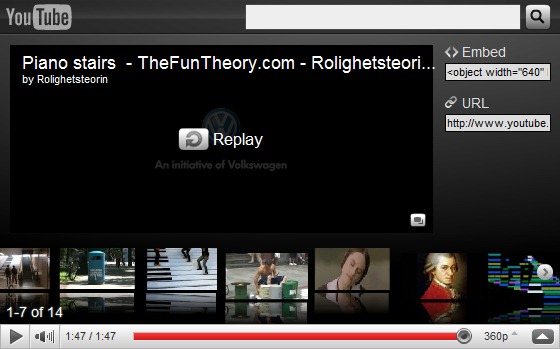


My take on this is: Motivation can come externally or internally. Which do you think works best for people? Which carries more weight? Which one carries lasting or far-reaching effects?
Your opinion is as good as mine.
Saturday, July 9, 2011
Mercedes – In Memoriam

Throughout the seven years I’ve lived in my neighborhood, I’ve made only a handful of acquaintances --- neighbors I meet when I take my walks; folks I see as I take out the garbage or park my car. Mercedes was one of them.
She was an older lady, probably in her early 70’s, who lived with her husband Dominic, presumably a retired New York firefighter. They appeared to be quite patriotic Americans. I always see a FDNY American flag draped on their balcony. Mercedes had been a Christian and had once invited me to church.
When our neighborhood was ravaged by hurricane Wilma in 2005, our house was one of the few that sustained damage. When the storm passed we found ourselves trapped inside the house. Tree trunks and branches had crashed onto our patio along with the roof . Shortly after, Mercedes came to check on us and she had a grocery bag which I thought in retrospect might have held a homemade dish. I didn’t invite her in for whatever reason only to realize how rude it was of me to have done that. Plagued by guilt, I passed by her house one time. She offered me a drink while we made small talk.
Over the years I would occasionally get a brief glimpse of Mercedes or Dominic as I passed by their house or on their morning or afternoon exercise, garbed, as it were, in their athletic shirts and sneakers. As much as I wanted to cultivate a friendship with her—having no friend of my own in our neighborhood--I was way too busy in my mind and finally lost interest.
A few days ago, I was on my way home after hiking when I passed by Dominic. I casually blurted out, “How’s Mercedes?” Dominic replied that she passed away in April, of a heart attack. It was very sudden, he added. The news stunned me. It was a moment of incredulity. All the way to the house I was gripped in some kind of shock. How can one be a neighbor and not know that a person in your street has died? I may as well be living in another city or country. I have been passing by their house presuming that Mercedes was inside. Life had gone on for me, while death had paid visit at a home just a few doors away.
I still see a vision of Mercedes standing alongside her husband—healthy and intent with the business of living, when in reality she had been gone and buried. Mercedes is gone. Even now, I am strangely in grief. I believe I am mourning the fact that I will never have a chance to see her again or strike that friendship with her -- a desire henceforth unfulfilled, an opportunity forever lost.
I still see a vision of Mercedes standing alongside her husband—healthy and intent with the business of living, when in reality she had been gone and buried. Mercedes is gone. Even now, I am strangely in grief. I believe I am mourning the fact that I will never have a chance to see her again or strike that friendship with her -- a desire henceforth unfulfilled, an opportunity forever lost.
I wished I could have said more meaningful words to Dominic even now as I imagine him living alone in that empty house filled with the memories of Mercedes. Out of words -- I only managed to put my hand to my chest and say that she was a good woman.
It may take a some time before this twinge in my heart goes away.. Or it may never go away. Regrets are hard to get over, no matter how small.
Dominic was going for the usual afternoon walk the day that I saw him. That time he was walking alone… a poignant picture of one man trying to live life after a loss.
I had lost one likely friend. He had, in fact, lost a wife.


Farewell, Mercedes!
Subscribe to:
Posts (Atom)